In this article
An Ashtanga yoga retreat is not a spa holiday. Into the shala on an empty stomach. Practise, sweat, shower. Wash your yoga clothes, hang up the mat to dry. Eat vegetarian food, go to bed early. Back on the mat the next morning.
And before the last day has arrived, people are already discussing when and where the next retreat will be.
We have joined Kino MacGregor and Tim Feldmann twice in Salento, in 2024 and 2025, spent a week with them in Miami in January 2026, and now come to Paros. We also spent a week with Adam Keen in Frankfurt in 2025. The formats differ. What follows mainly describes daily life on the retreat weeks with Kino and Tim in Salento and on Paros.
Mysore practice: how it works and how long it takes
At the centre is Mysore practice, named after the city in southern India.
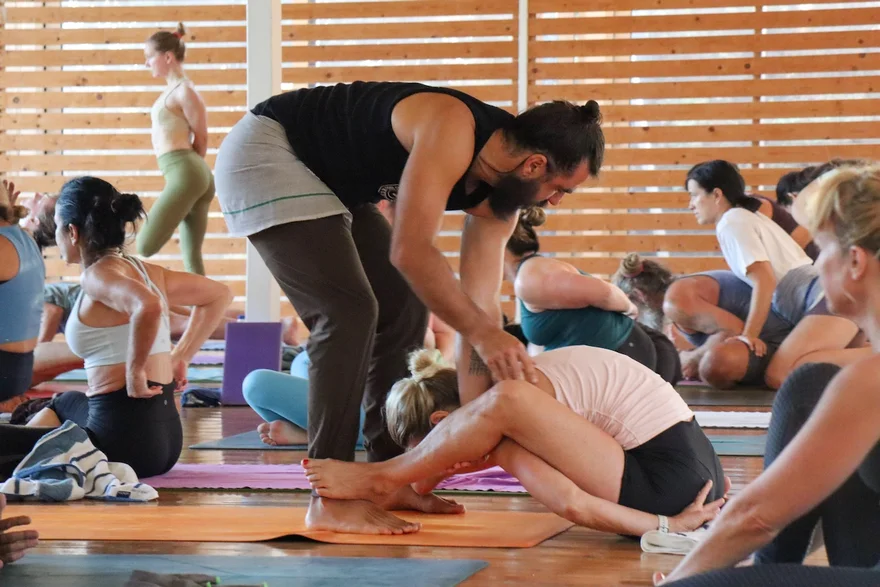
Each person practises a set sequence of postures — asanas — linked by movement coordinated with the breath: vinyasas. These sequences are called series. You work from memory, without continuous instructions or someone demonstrating every movement. Teachers and assistants move around the room, helping individually. Beginners and experienced practitioners can therefore practise together, each at their own pace.
Our practice takes about an hour and a half, including the final rest, Shavasana. Others finish sooner or practise longer. This is the format on four or five mornings of a retreat week.
Here, we cover the questions you might not even know to ask before your first week. Our personal account tells the story of how we found Ashtanga yoga and why we keep going.
Before practice: showers and breakfast
The day does not begin in the shala, the practice room. We get up in good time, shower and use a little body spray against the smell of sweat to come. We will sweat anyway, but hands-on assistance brings people quite close. Arriving freshly washed is a courtesy.
We skip breakfast before practice. There is not much we want to attempt on a full stomach. Coffee, however, is part of the routine. We bring our portable espresso machine.
What to bring into the shala
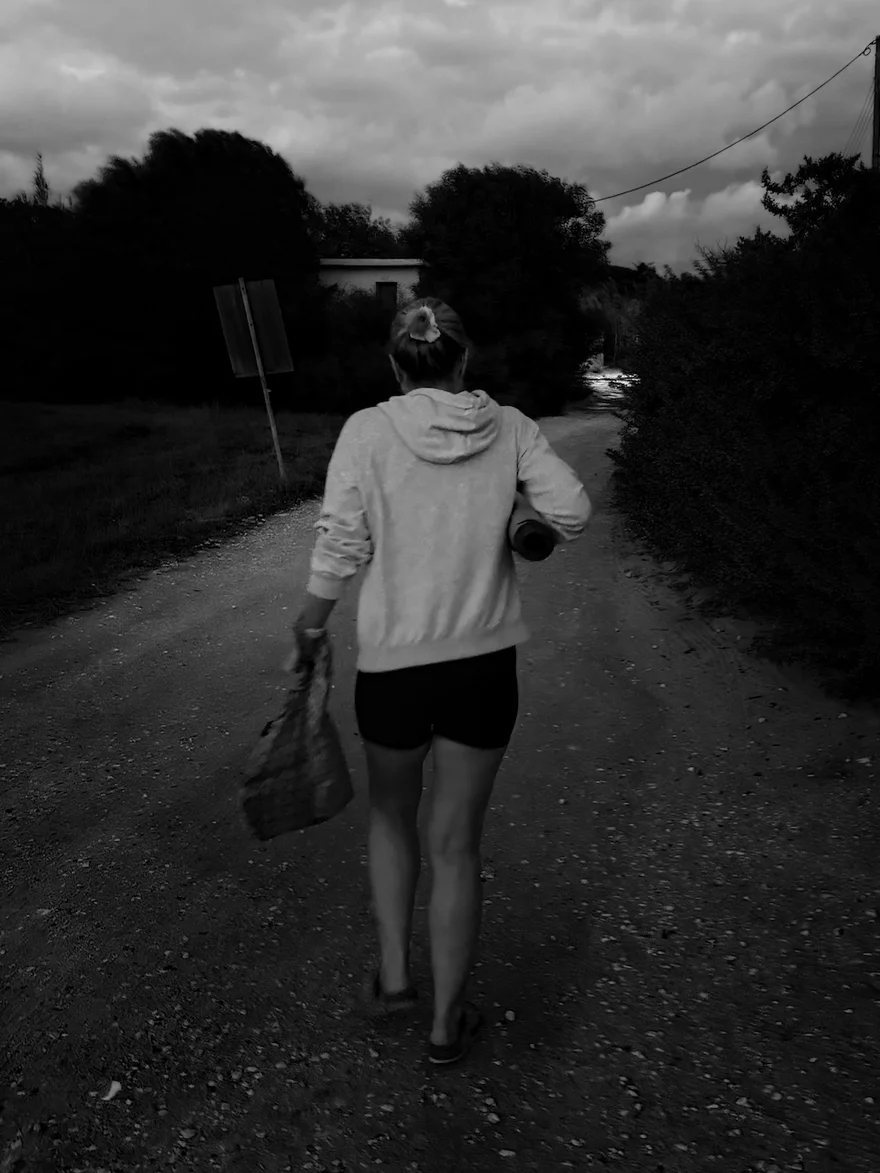
We need very little: a yoga mat and a small towel. Mats were available to borrow at the retreat centres, but most people bring their own. So do we. The towel dries sweat, helps prevent slipping in some postures and can be used by teachers when assisting.
Shoes stay outside; valuables go at the edge of the room. Water bottles are expressly discouraged at these retreats: you are asked not to drink during practice.
Phones, on the other hand, are not automatically forbidden. Photographing or filming your own practice is accepted; including others requires their consent. Calls and browsing do not belong here. Best option: flight mode.
Starting time and opening chant
Mysore practice has an advertised start time, usually 7:30 or 8:30 am on our retreats.
We are generally in the shala thirty to forty-five minutes before that, as are many others. Mats are carefully aligned, fairly close together. Everyone begins differently: meditating, warming up, stretching, simply looking around.
At some point, you start. Ekam — inhale. One — breathe in.
Shortly before the advertised time, the teachers and assistants enter. Around then, someone calls “Samasthiti”. We come to the front of our mats, stand upright, bring our palms together at the chest and sing the Ashtanga yoga opening chant. Usually, the teachers lead a section and we repeat it together.
Then everyone continues practising.
Yes, continues. Kino and Tim encourage us to begin before the shared opening. The sun salutations help us warm up and generally require little assistance once we know them. Starting early leaves more of the teachers’ time available for the more difficult bits afterwards.
It helps to know this. A starting time by which you are expected to have started is rather unusual outside a shala.
Assistance and your own limits
When we need help during practice, a searching look and a short wait are usually enough. We have also learnt the signal of crossing our arms over our chest. Often, someone comes over without being asked because they have noticed something.
Assistance takes many forms. Sometimes it is an explanation. Sometimes a light touch directing attention to a particular part of the body. Sometimes someone provides substantial physical help to move into a posture.
For me, one example is Marichyasana C, a seated twist. One arm wraps around the bent leg, the other reaches behind the back, and the hands are supposed to meet. I cannot make that bind without assistance. Even with help, it is a struggle. With help, I get a sense of how the posture can feel and what I need to work on. It can be intense — more physical than in many other yoga classes I have known.
If you do not want help or touch, say so or signal it. Your feedback matters during an adjustment too. Even with help, you still need to recognise and respect your own limits.
Valuable as the teachers’ time is, there is no skipping your vinyasa. After helping me on the right, Kino smiles and cheerfully says, “Vinyasa.” The transition through a low push-up, upward-facing dog and downward-facing dog. My yoga burpee. Then she helps on the left.
Experience, modifications and progress
Most participants know their series and work through the familiar sequence. Some are tackling advanced postures, others the first ones. Occasionally, simply watching can be illuminating.
Many have their particular difficulties: lotus positions, shoulders, strength, backbends. Modifications and props are naturally possible. At the same time, Kino and Tim are fairly consistent about not letting us settle too comfortably into them.
The idea really is to need fewer modifications over time and move towards the full expression of a posture. Whether that takes a week, a month, a year or a lifetime remains open. Nobody has to achieve by Friday what defeated them on Monday.
We have also met participants trying Ashtanga yoga for the first time. They are usually taught as a small group, with extra explanations of the sequence. As the week progresses, they are encouraged to practise more of it independently. That does not mean every retreat suits everyone equally; before booking, we would check that the particular programme fits our experience.
We have never felt judged, either by other participants or by teachers. Everyone practises, explores their limits and returns to the mat the next day. Almost entirely on their own. Yet not alone.
Finishing, showering and brunch
The main sequence is followed by the finishing postures, leading into the lying-down rest, Shavasana.
Depending on the size of the shala and the number of people, we pick up our mats and move to the back of the room. It is supposed to be quieter there, away from the continuing practice and adjustments. It also makes space for a second group, if there is one.
The quiet sometimes has its limits. As everyone gradually brings their mat to the back, there is a steady coming and going.
Afterwards, the shower calls first. Hang the mat up to dry. Wash the sweaty yoga clothes and hang those up too. Then brunch. Vegetarian.
Sometimes we sit at big tables and talk. Sometimes you do not want to say much after practice. Both are fine.
Afternoon workshops
There are workshops on several afternoons. Kino and Tim say they choose topics partly according to what they see the group needs. Some recur: backbends, upper-body strength, arm balances, pelvic floor.
We gather in a relaxed atmosphere. Kino or Tim talks about the subject. Then they begin introducing simple exercises. Then harder ones. Then longer ones. Suddenly, we are sweating again.
Sore muscles the next day.
Here too, everyone goes as far as they can. If the arm balance or headstand is out of reach, you practise a preparation. At the next morning’s Mysore session, the afternoon’s advice is still in our heads. Later, we have to remind ourselves.
Free time, outings and dinner
There is not actually that much free time. Perhaps two hours between brunch and the workshop, a little afterwards. Or an afternoon without a workshop. There is often a group activity: a walk, an excursion, time at the beach.
On Paros, we liked spending about two hours by the sea after brunch. Our extended “Shavasana”. The proper one was already over.
Free afternoons allow longer outings too. A hire car can be useful. In Salento and on Paros, the retreat centres were not right beside the places we otherwise wanted to visit. Miami was different: a week at an urban studio.
The evening programme is uncomplicated. Dinner, often around 6 pm. A little more conversation. Then back to our room. Usually, we go to bed early. We have an early start. And we are tired.
Led class and questions on the final morning
Kino and Tim end the week with a led class. Everyone practises the first series together, with the postures called and movements counted in Sanskrit. The opening chant together at the start, the closing chant at the end.
There is less individual assistance; the assistants often join the practice themselves. It is demanding too. The pace is brisk, and some postures are held longer than you might hold them alone. Anyone who needs a break can take one while the group continues.
When thirty or forty people move with the same rhythm and breath through something they have practised many times, it creates a particular feeling. After days of everyone following their own sequence, the whole room now moves together.
Afterwards, there is usually a “conference”: an open question-and-answer session. A difficult posture? Finding room for yoga in daily life? The Yoga Sutras? Or anything that surfaced during the week without an opportunity to discuss it.
Departures and transfers
After that, things tend to move quickly. Transfers are booked; flights and ferries have their schedules. A group photo, a snapshot with Tim and Kino. For many, it is back to work and family.
We have the privilege of continuing our travels.
And still, we are already wondering when we can come back. We feel good. Proud to have completed this demanding week. Full of new ideas, and with a fairly clear sense of how much there is still to learn.
That, too, is wellbeing.