I am lying on my mat. On my back, knees bent. A brief pause in the sequence. I am exhausted and, somehow, moved. If a tear came now, it would not surprise me.
It is usually after the wheel pose, Urdhva Dhanurasana, that I reach this point. It took me more than three years to manage that backbend without help. Now I can get up. Three times. Just about. Afterwards, I need to lie down for a moment.
The first series is quite enough
In Ashtanga vinyasa yoga, we practise a set sequence of postures, linked by transitions and synchronised with the breath. That connection between breathing and movement is the principle of Vinyasa. There are several series. We practise the first, the Primary Series. “First series” sounds manageable. For us, it contains quite enough.
Even between the seated poses, there is plenty to do. Back onto the hands, jump back into a low push-up, Chaturanga Dandasana. Inhale into upward-facing dog, Urdhva Mukha Svanasana; exhale into downward-facing dog, Adho Mukha Svanasana. Then jump the legs forwards between the arms again.
Some people seem to float through. Mine is more of a hop.
There are also plenty of forward folds, arm balances and variations on the lotus position, Padmasana. In sleeping tortoise, Supta Kurmasana, you are even meant to cross your legs behind your head.
Much of this first series is difficult. For us, very difficult. Some of it impossible.
No room for anything else
After the first few sun salutations, I often find myself in a state that could, very generously, be described by a line from the Yoga Sutras: Yogaś citta-vṛtti-nirodhaḥ. Roughly: yoga is the cessation of the fluctuations of the mind.
Generously, because I have not reached some exalted mental state. I simply need all my attention for the practice. For the vinyasas, which do not stop being strenuous as I improve. For the asanas, the postures themselves. For synchronising breath and movement. For the gaze, Drishti. And for the sequence, which still requires concentration despite all the repetition.
Whether that counts as meditation, I do not know. In any case, I do not need to let thoughts drift past like clouds. There is simply no capacity left for them.
It cannot be the exertion alone. When I run, my body can put one foot in front of the other for ten kilometres while my mind reviews yesterday, plans tomorrow or sketches an article for Unterwegs. Aufgefallen. In Ashtanga yoga, I am busy with Ashtanga yoga.
Angie and I are not exactly typical Ashtangis — at least not according to the picture in our own heads. We started in our mid-fifties and have mostly learnt and practised online. We do not manage five or six practices a week. We run, cycle and do strength training. We travel a lot. That matters to us too. There are no teachers nearby with whom we could practise regularly.
Still, we keep going. And now, once or twice a year, we travel to Kino MacGregor and Tim Feldmann to spend several days doing mainly what already pushes us to our limits at home.
Why, exactly?
A year, five years, a lifetime
I first encountered Ashtanga yoga during the pandemic, when there was a moment when it almost felt as though even going out for a run might be forbidden. I started with Richard Freeman and Mary Taylor. Online.
I liked the physical aspect. I liked their warm, dry humour, and the way they taught without ever calling the rigour or discipline of the method into question.
I used to smile when Mary said a particular asana might take a year to master, or five years… or a lifetime.
Now I know what she meant. And that she was right.
Angie had practised yoga for many years before that and was not immediately keen to join in. Why take up something so repetitive, so physical, where even the first series asks you to put your legs behind your head? Why do something you know from the outset you will never be good at?
By then, I had moved to Omstars, Kino’s online platform. Kino takes yoga seriously. Her enthusiasm is infectious. When I read that she and her husband Tim were offering an autumn retreat in Puglia, I tentatively floated the idea.
Angie agreed for my sake. We signed up. And began to practise seriously.
We had three months.
Our first time in the shala
On the first evening, we went for a walk in the dark around the retreat centre in Salento and met Kino. She was a little tired from travelling. We were nervous.
She reassured us. If we could at least remember the standing postures, she and the other teachers would help with the rest.
We knew more than the standing postures. We remained nervous all the same.
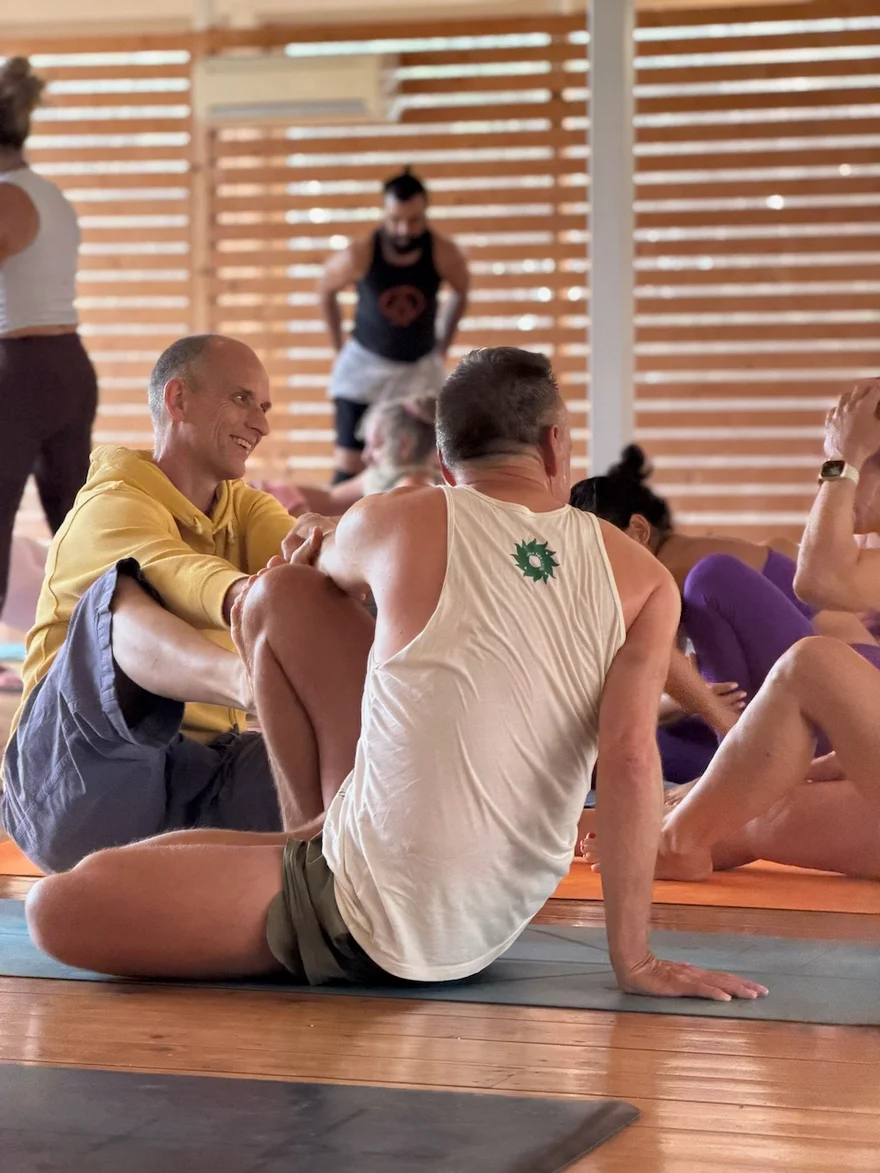
Looking around the shala — the practice room — the following morning seemed to confirm our suspicion that we were rather unusual members of the group. Around us were current and former dancers, yoga teachers and people who had been practising Ashtanga yoga for years. Few had as little experience as we did.
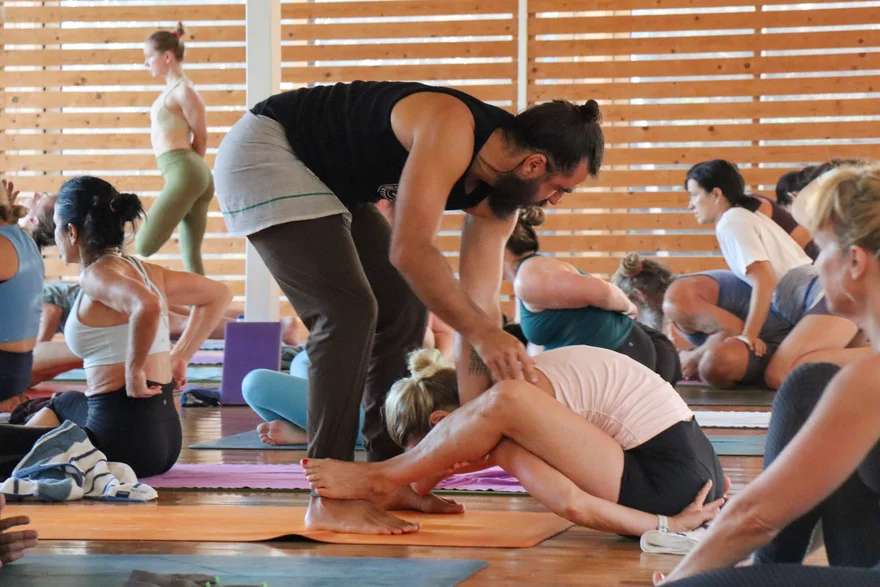
The routines of Mysore practice were unfamiliar too. Mysore is the city in southern India that gives this form of teaching its name. Everyone follows their familiar sequence at the pace of their own breath, while teachers provide individual support.
That was the theory. But when do you start? What do you do if you need help or cannot go any further? Do you just leave when you finish?
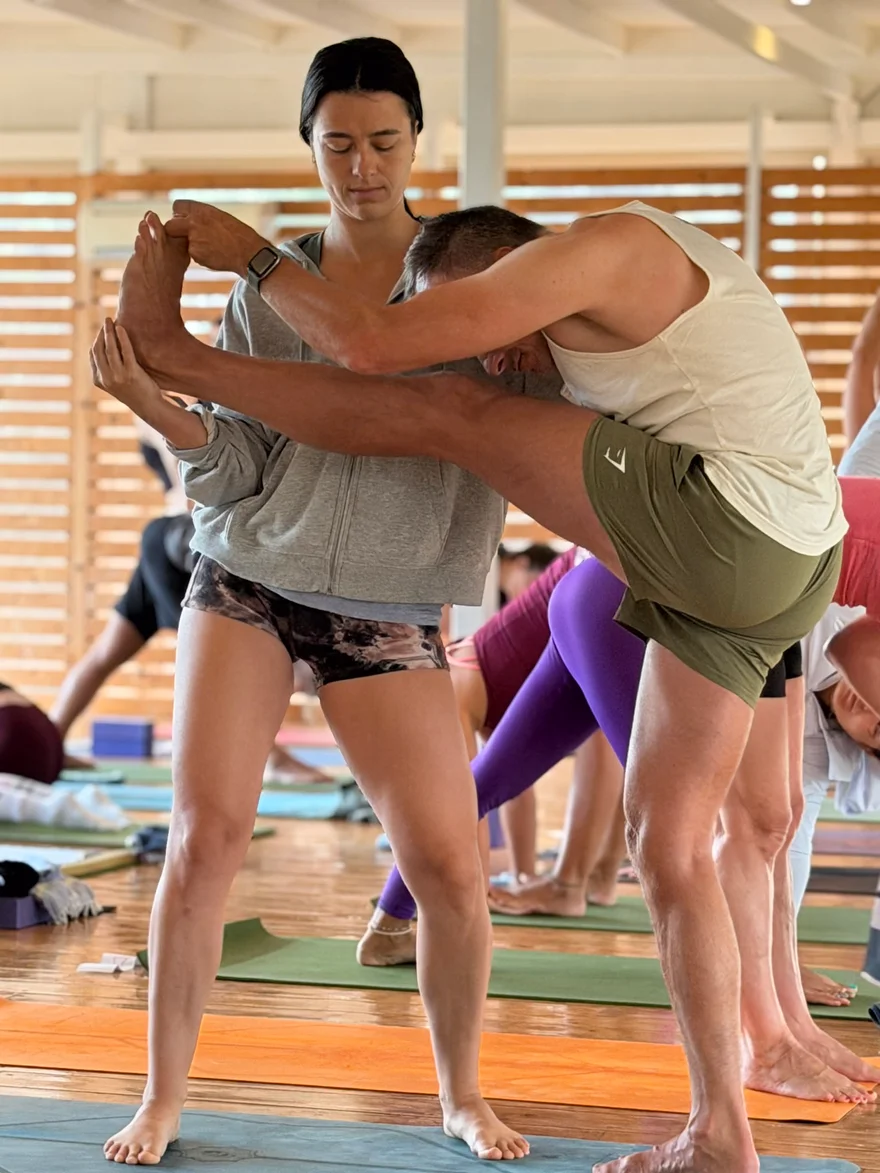
After the first sun salutations, most of that hardly matters. Everyone gets on with their practice as best they can. We do not feel judged. Kino, Tim and the assistants help and correct us, while also maintaining the discipline of the practice.
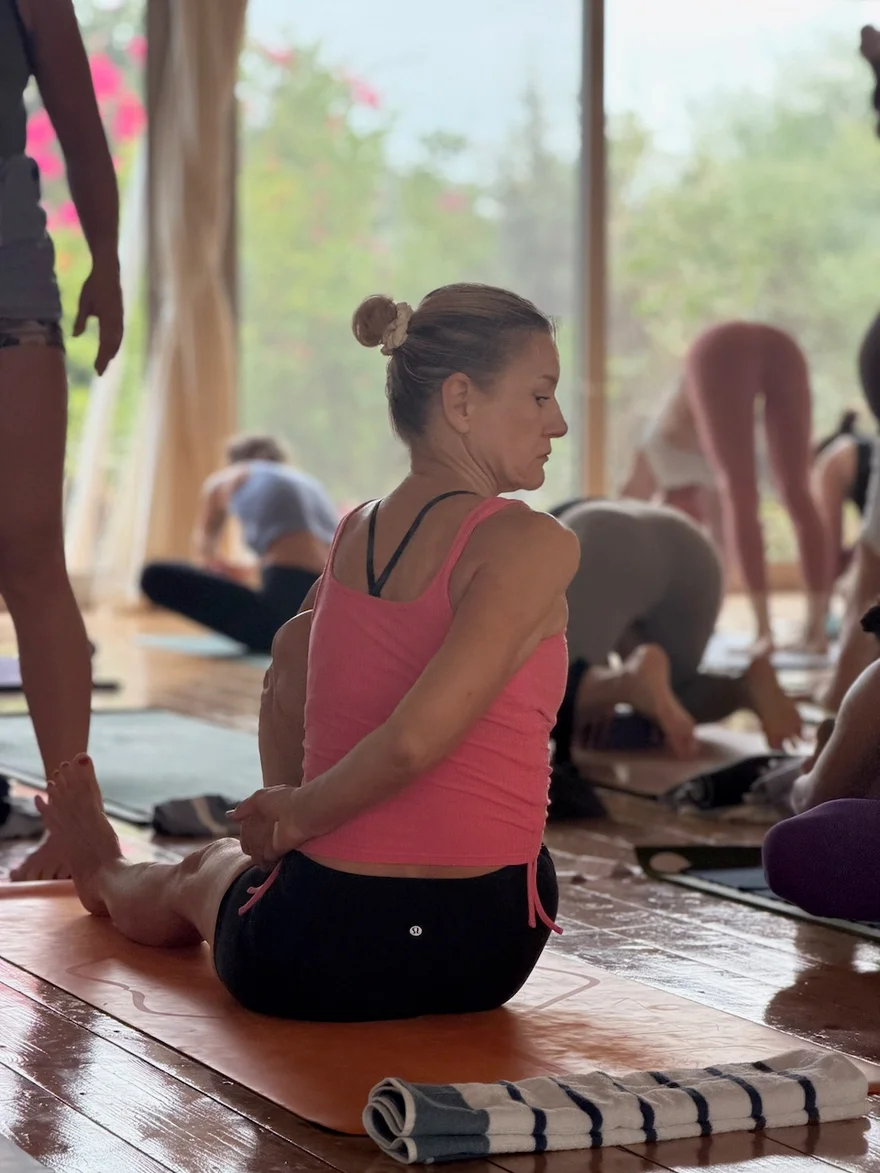
People are practising all around us, and we join them. The sound of breathing becomes a constant background. The atmosphere is focused, intense, infectious. Occasionally, a brief laugh or a “Good job!” crosses the room.
Many are working on more advanced asanas than we are. Almost more impressive is seeing strength and elegance together even in the simpler poses. Yet nobody seems to need an explanation of why our own limits give us so much trouble.
Still, sometimes I glance rather un-yogically at the mats around me and marvel at how far other people’s limits lie beyond mine.
Our practice lasts about an hour and a half. Some afternoons bring another two hours of workshop.
It was one of the most strenuous weeks of my life.
Shortly afterwards, we booked the next retreat.
Coming back
We had also met people whose everyday lives were very different from ours. Some much younger, some with weeks or months of practice in India behind them, some organising their lives around yoga to a far greater extent than we do. Over meals and between sessions, we tell one another about it. We find ideas and help. Shared practice gives us common ground despite our very different experiences.
Later, we travelled to Miami to practise at Kino and Tim’s studio. Now Paros. And we are already making plans for next year.
We cannot entirely put into words what draws us to them. We like the way they live and teach yoga. Their support in the shala, and the sometimes surprising reserve when we meet them outside it.
We practise with them online too. Sometimes with the same video for months. There are also Kino’s books and thoughts, which can occasionally reach us through a single sentence on Instagram.
Couldn’t I feel it?
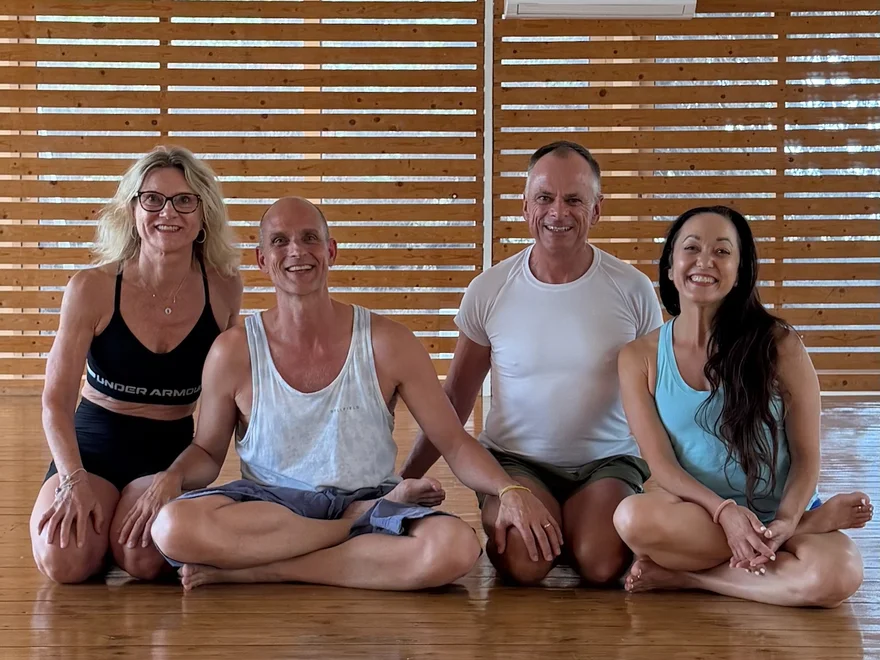
On Paros, we asked Kino and Tim whether they could see any progress in us at all. Their answer, in essence, was that our practice was much more settled, and becoming more so. Tim asked me whether I could feel it.
I am still thinking about that. And about what “settled” means to me. More grounded is part of it. More secure in the sequence; body, mind and breath better connected. Less occupied with managing the practice, more present within it. A little closer to meditation in motion.
For me, that can also mean trying something. The setting is familiar now. We know how the shala works. When to begin, how to get help, when to leave. Meals, drinks, showers and laundry all have their place in the day too. It sounds mundane, but it makes a difference.
And physically, things do change. We no longer need quite so many modifications. Angie mainly needs them for lotus positions; I need them for postures where the hands are supposed to meet behind the body. After twenty-five years at a desk, my shoulders are not immediately cooperative. At the same time, we both notice that the practice helps us stay mobile — and become more mobile in some ways. Managing wheel pose after more than three years is part of that.
But can I feel what Tim means?
In a way, yes. I also know yoga is not about perfecting a difficult asana. Then I look at the photographs from the shala and see almost nothing but my limited mobility. How far I am from the posture I have in mind. I can name my progress and still see what is missing first.
Perhaps that blocks my view of something less easily photographed. But for now, my honest answer to Tim is: I do not know.
Begin. Then be there.
“Keep practising,” says Kino.
We do. At home and away. The familiar order helps: we do not have to decide what to do today, and we can practise without instructions. We take our mats travelling. At home, our children are occasionally “treated” to breakfast with a view of two downward-facing dogs when the living room becomes a shala on Saturday morning.
Our roles have shifted. At first, I persuaded Angie to try it; now she often gets me onto the mat. She is more disciplined about it than I am. Since preparing for our first retreat, she has recorded every practice in a notebook.
We do not always feel like it. Once we begin, though, something happens. Sometimes it goes really well. The art is in starting, Angie says. You do not have to wait until you feel like it.
Kino’s dedication in one of her books matters particularly to her: “Practice with all your heart and soul.” When we are on the mat, we want to be there. Engaged with the movement, the posture, the breath. The shopping list can wait.
It need not be the full series every time. Eight sun salutations can be enough if we give them our full attention. Kino says so. For us, that offers a way to practise when an hour and a half is too much. Doing less need not mean being only half present.
The idea reaches beyond yoga: engaging with what you are doing instead of already thinking about something else. Some days we manage it. Others, not at all.
Beyond the mat
Angie says she struggles to explain to friends why she practises Ashtanga yoga. Her original objections have not disappeared. The sequence repeats. It is demanding. Some postures remain out of reach.
When we discussed the first draft of this article, she pointed out how little I had said about what stays with us outside the practice. I had apparently been looking for a more fundamental transformation, something that would make yoga’s effect on us unmistakable. I had rather hurried past the smaller steps.
Beginning is one of them. We are also more aware of our breathing now. In everyday life, we find it can help us deal with tension, emotions and pain.
Then there is Tim’s phrase “Undercut the drama”, which Angie quotes quite often at the moment. He said it in an Omstars video during Utpluthih: towards the end of practice, you press into your hands and lift your body off the floor in lotus. For ten long breaths. A strenuous posture in which time seems to stretch, while your mind asks when it will finally end.
The phrase also fits remarkably often outside the shala. A cold starts, and the whole film is already running in your head. How bad will it be? How long will it last? Can we still go on our planned trip? Or the coffee machine suddenly breaks, and the faulty espresso maker takes up an extraordinary amount of room in your life.
“Undercut the drama” neither clears your nose nor repairs the machine. But it reminds us how much we add in our minds to an already annoying situation.
Recognising that is a start.
Angie reminds me to notice the small changes at all. Beginning when I do not feel like it. A breath. The moment we realise that the film in our heads is becoming longer than necessary.
That still does not answer Tim’s question for me. But I take it with me.
After the wheel, I lie on my back, knees bent. Just for a moment.
Then on to the seated forward fold, Paschimottanasana.
Ten breaths.