We visit Mycenae. Agamemnon’s legendary home, the Lion Gate, the immense Cyclopean walls. We read, listen to the audio guide and are impressed. As you tend to be in a place like this.
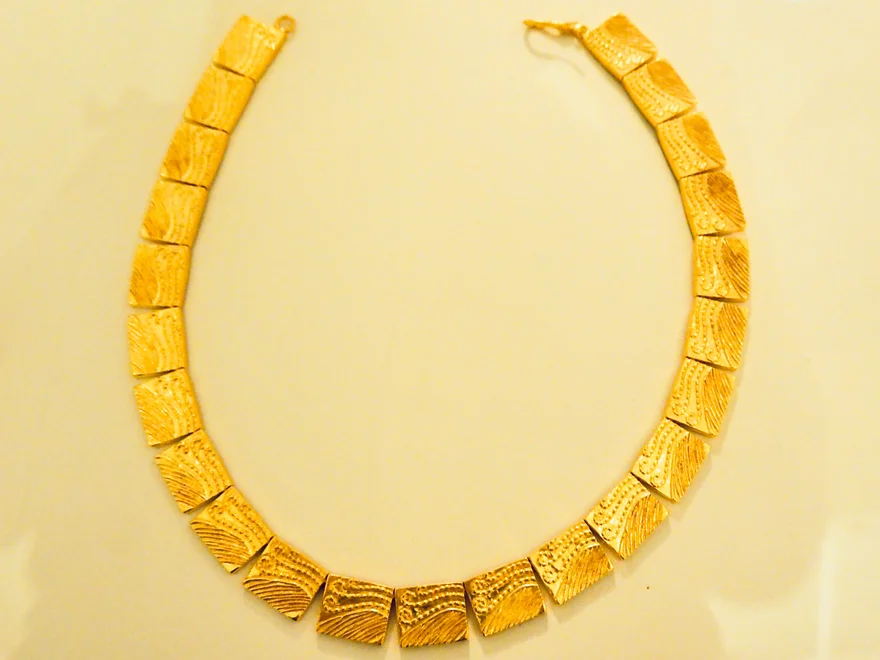
Then we go into the museum. And stop in front of a necklace.
That could be in a shop window at home
Angie is immediately drawn to the gold jewellery. I think of the goldsmith’s workshop in a side street off the town hall square back home. This necklace could be in its window. We would stop, go inside and perhaps ask the price. Other pieces here appeal to us too. Without the qualification: remarkable for its time.
Suddenly, we see the pottery differently as well. There used to be a pottery shop where we live. Handmade pieces, carefully displayed, priced accordingly. Some of the vessels from Mycenae would have fitted in beautifully.
We came to look at a distant past. Instead, we find things we would wear today or put in our own home.
The Bronze Age sounds different
Why does this surprise us so much?
Around 3,500 years. I can read the number, but I have no real feel for that distance. In my head, the Bronze Age sounds very early. And “early” slips remarkably easily towards “simple”. “Primitive” is not far away.
Yet a necklace surprises me because it suits my present-day taste. Evidently, I had expected less of the people who made it.
There were specialised workshops here, elaborate administration and far-reaching trade links. The Mycenaean world belonged to an interconnected Mediterranean. Read Eric Cline’s 1177 B.C. and you encounter a complexity that has little to do with my hazy idea of the Bronze Age.
The wall and the Lion Gate now occupy my thoughts differently too. I had marvelled at their size. Now I think more about the people behind them: the planning, the stoneworking, the coordination of materials, labour and experience. How little of it I could do myself.
Progress in my pocket
I walk around the site in high-tech trainers, carrying an iPhone. We humans have certainly come a long way.
But how much of that is my achievement?
I can use the phone. I could not build it. I could not even make the shoes on my feet. Nor, for that matter, the necklace in the display case — with modern tools any more than with ancient ones.
The phone is evidence of technological progress. It says rather less about my personal superiority to a goldsmith from Mycenae.
I use knowledge and skills developed by other people. Having access to those possibilities says little about what I could produce myself.
At first, I see a goldsmith’s work in the necklace. But other people stand behind it too: those he could learn from, those who supplied materials, made tools and enabled him to work.
What makes skill possible
The fall of the Mycenaean palaces did not suddenly erase people’s talent, experience or ideas. Important works survive from the period when the palace system was breaking down. But the conditions in which those abilities could produce something changed.
Skill needs opportunity. Someone must be able to learn and practise. Materials and tools must be available. Elaborate work takes time, and people who consider it worth the effort. Whether talent develops into something also depends on whether it meets those conditions.
When workshops, trade links and patrons disappear, more is lost than a market. What people can do with their skills changes — and so does what others can learn from them.
I seem to have thought of progress as something that reliably accumulates. But the fact that people once made something does not mean later societies will offer the same possibilities. People can possess skills for which their world no longer has room.
I think again of the necklace and the goldsmith back home. Millennia lie between them. That we still find the piece beautiful is one remarkable thing. The kind of world it takes for someone to make it is another.